Tech Neck: Unraveling the Puzzle of Forward Head Posture
I’m sure you’ve heard of ‘tech neck’; it’s everywhere. While the name is trendy, the strain on your spine is anything but. Massage therapists, chiropractors, and physical therapists have worked for years to treat the symptoms of tech neck. But what actually causes it? How can we aid in healing the muscles around the area more permanently to decrease pain for longer periods of time? We’re going to take a deep dive into tech neck: how it starts, what muscles are involved, and how massage therapy can help you long-term to keep the pain associated with tech neck at bay.
What Is Tech Neck?
Tech neck is termed as such because of our everyday usage of technology. Its true name is Forward Head Posture (FHP) and can apply to any postural deviation where the head is chronically held in a forward position. It causes a prolonged flexion of the neck in which certain muscle groups are held in these positions for too long, causing strain and fatigue, and eventually chronic neck pain if left untreated. “FHP is an overuse repetitive injury” (Muscolino). Thinking about it in this way allows us to observe and change our postural patterns throughout our day. We can actively work on the way we sit at our desks, how much time we spend on our phones, and what kinds of stretches or exercises to do to help our condition.
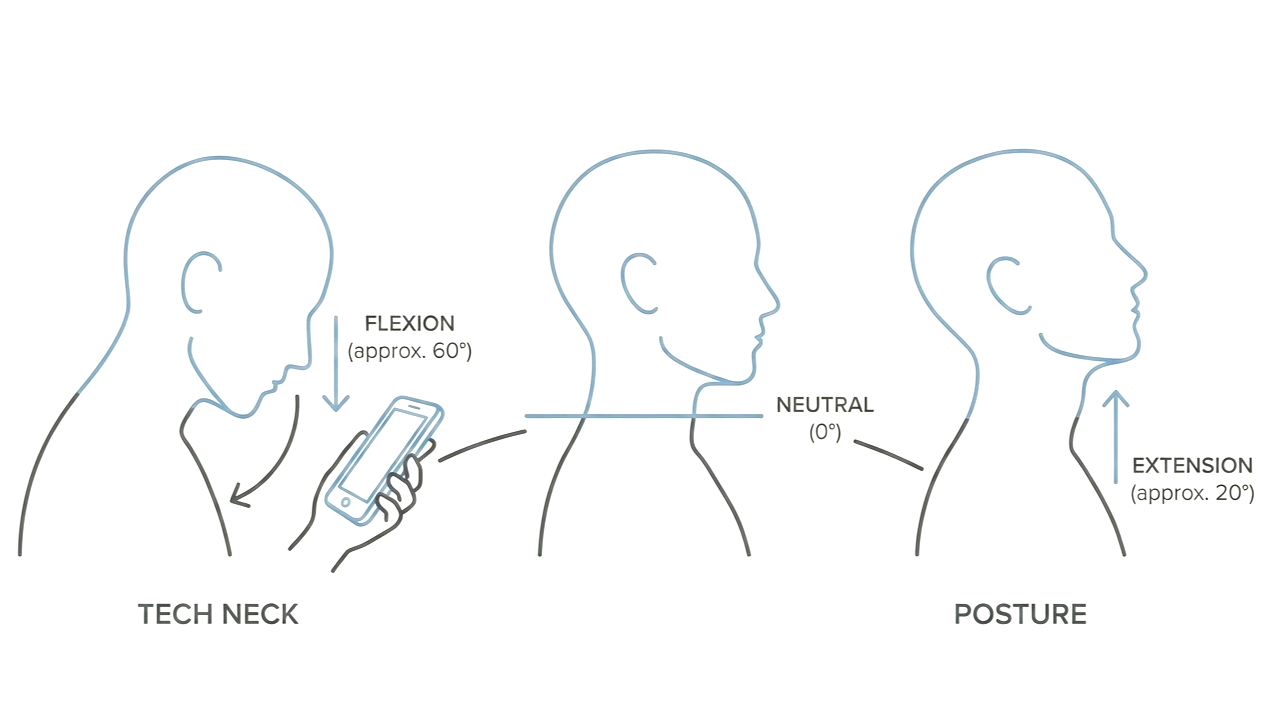
Flexion is a decrease in the angle between the neck and the torso, shown here
Extensive time on mobile devices causes a shortening of the lower neck flexors, or front of the neck muscles, and the prolonged activation of the neck extensors, or muscles of the back of the neck and the upper trapezius. Eventually, the head and neck and even upper shoulder muscles learn to hold this position for longer periods of time and this affects where we hold our heads even when we are not on our phones. Informally, this is called muscle memory, but it is more accurate to say that our neural pathways have developed around this postural deviation. After that? You guessed it. We start experiencing intense pain and trigger points (knots) in both muscle groups from our heavy heads being held in unnatural postural patterns all day. The head actually gains 10 pounds of weight for every inch forward it sits. So, a head that sits 2 inches forward would cause a whopping 20 pounds of extra weight on the neck, causing significant strain since these muscles have to work much harder to support the head (Whitten).
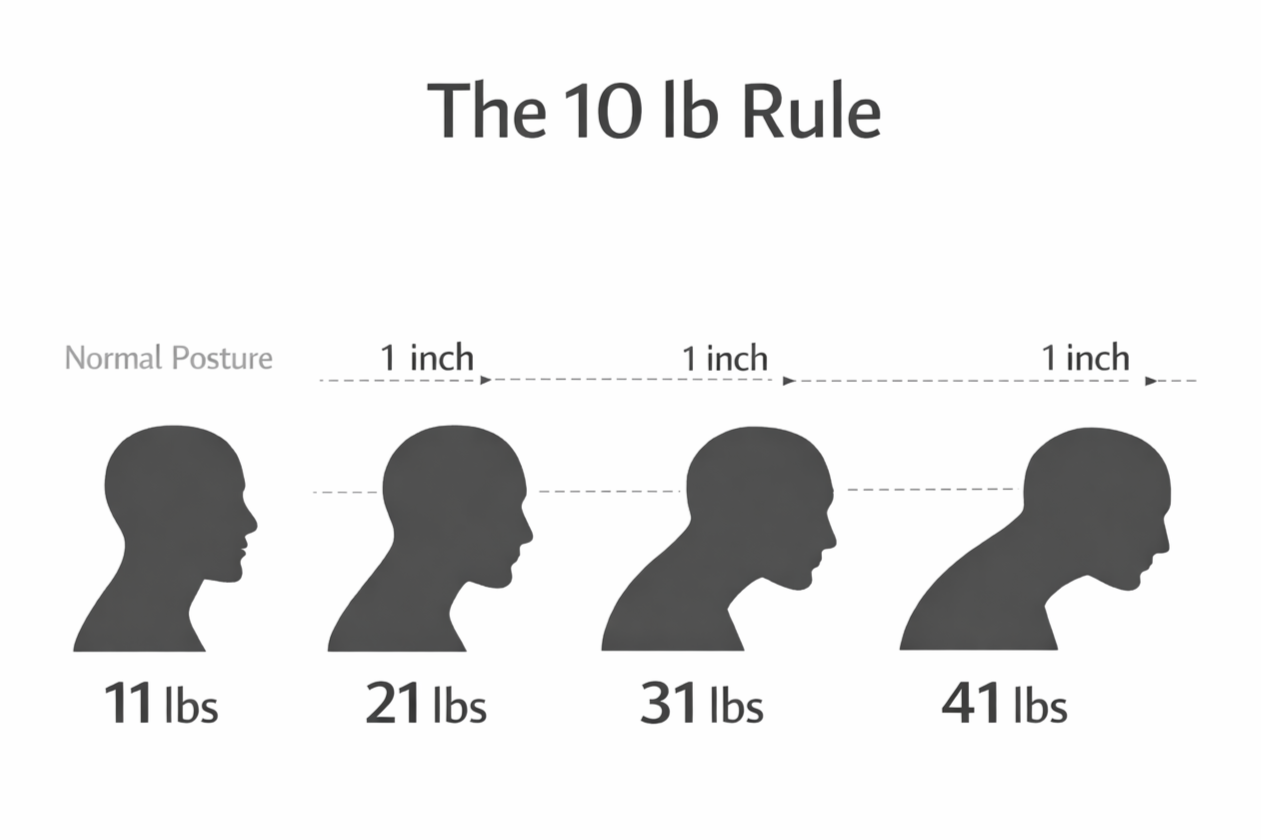
The 10lb rule demonstrates how the added weight of FHP affects the back and shoulders, increasing discomfort and pain and decreasing range of motion and structural integrity of the spine
What makes tech neck especially complicated is the addition of a short extended angle - so the neck is flexed down towards the chest, but for folks with chronic FHP, there is a slight extension of the upper neck; the jaw protrudes forward so the eyes can see the screens (and the horizon) better. This creates a postural puzzle that needs to be unraveled in order to alleviate pain caused by this dysfunction. If left untreated, the body will continue to shift in order to accommodate the FHP, creating flexion in the upper back and hyperextension in the spine. This creates postural issues throughout the entire body that all started with that forward head tilt, so it goes without saying that treating FHP seriously and correctly can positively change the postural patterns and pain levels in the rest of the body.
Which Muscle Groups are Involved?
I’ve mentioned neck flexors and extensors, but let’s break down the exact muscles that play the biggest factor. To truly understand the mechanics at play, I’m leaning on the expertise of Gary Salinger. His book, Body Insight, serves as the foundation for this look at the specific anatomy and actions of the neck muscles.
I. Neck Flexors:
The SCM of course! The sternocleidomastoid is the large muscle on the front of the neck. The origin of the sternal head is the manubrium of the sternum, and the clavicular head sits on the medial part of the clavicle (collarbone). It attaches to the mastoid process and the superior nuchal line of the occipital bone. What this means for those of us with FHP is that we have this large, strong muscle in the front of our neck that spans from the very top of our chest to the head. In FHP the SCM is shortened and overactive from the head sitting forward constantly. This muscle is responsible for flexing the neck (looking down) and assisting with extension (looking up). It also works to rotate and tilt the neck. A decreased range of motion in the neck almost certainly means the SCM is involved.
The scalenes are also an important neck flexor group, but are considerably more difficult to work with. Specifically speaking of the scalenus anterior and the scalenus medius, they originate to the transverse processes of the third through sixth cervical vertebrae and attach to the inner border and upper surface of the first rib. These muscles are small but mighty, as they work together to flex the neck, draw the head ventrally, elevate the chin, and are even pulled upwards when we breathe in. Being responsible for so many things, they are very important in addressing FHP and are often chronically overactive, leading to headaches and sometimes even TOS (thoracic outlet syndrome).
II. Neck Extensors:
The body requires opposite force in order to counterbalance gravity, and in the case of Tech Neck, this would mean that the neck extensors are doing a heck of a lot of work to keep the head from hitting the chest altogether, or to keep the body from falling forward.
The splenius capitis and cervicis muscles make up the neck extensors. The Splenius capitis originates at the spinous processes of C4 to T3, and attaches at the mastoid process. That is quite a long muscle! Reaching all the way down the mid back just below the upper trapezius, this muscle is paramount in neck extension and in keeping the head aligned with the shoulders. In FHP, we see the splenius capitis and cervicis muscles elongated, or weakened, as the heaviness of the head pulls these muscles forward and down. The splenius cervicis’ origin is the spinous processes of the third to sixth thoracic vertebrae, and they attach at the transverse processes of the second or third vertebrae. While they are much smaller, they do play an important role in stabilizing the neck. Together, the splenius muscles work to extend and rotate the neck. They are the antagonist muscles to the flexor group, meaning they work in opposition to maintain support during movement and stabilize the joint (Salinger).
Semispinalis capitis muscle is a very long and deep muscle in the upper back and neck that also persists in FHP and in chronic extension can cause tension headaches and migraines. This muscle originates on C4-T6 and attaches at the occipital bone (the bump on the back of the head where the neck meets the skull). I have found through years of addressing Tech Neck that trigger points in the occipital region have a profound effect on reducing pain here, though it is crucial to relax and remove adhesions from the splenius muscles first in order to reach this muscle and the suboccipital group.
The suboccipital group is composed of four bilateral tiny muscles (eight in total) that stabilize the antilanto-occipital and atlantoaxial joints - this would be where the base of the skull sits right on top of the spine. I’ll spare you many intricacies of this muscle group as it could really be a topic all on its own, but you should undoubtedly know how important these tiny muscles are when it comes to addressing FHP or other instances of neck pain.
III. Other Involved Muscle Groups:
The upper trapezius and the levator scapula, the muscles on the top of the shoulders, experience excessive strain and discomfort with FHP in order to keep the head upright. As mentioned previously, the head gains 10 pounds of weight for every inch forward it sits. This means that the upper traps (which has many origin points, the most important for FHP being the external occipital protuberance and attaching to the lateral third of the clavicle) must carry this weight, and the levator scapula (originating at the posterior tubercles of the transverse processes C1-C4 and attaching to the medial scapula) helps to compensate for the surrounding muscles by assisting the traps in holding the head up. These muscles must also be addressed in order to alleviate pain and assist in correcting FHP.
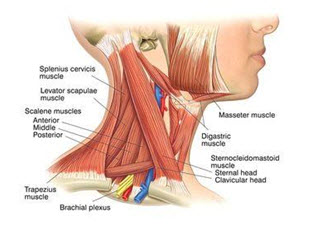
Cervical Neuro-Muscular Anatomy
The various muscle groups involved with tech neck: SCM, Splenius Cervicis, Levator Scapula, the Scalenes, the Upper Trapezius.
As you can see, FHP, or Tech Neck, is a complicated issue. It’s no wonder that other postural deviations can stem from this initial cause. Therefore, the treatment plan must be multi-faceted. The approach works best when you’ve got a bodyworker who intimately understands the causes of FHP and can work with you to release these muscles that are overly tightened and strengthen those which are weak. And, of course, the treatment will be most effective if you are also willing to work on your care outside of the treatment room.
A Note on Meta Expressions
I was fortunate enough to attend Gary Salinger’s school, Healing Arts Institute in Fort Collins, Colorado from 2016-2017 and was specifically taught Body Insight - which is an integrative neuromuscular modality. We also learned about specific meta expressions that muscles can have - or emotions that are tied to them through neural pathways. “Meta expressions are words or expressions that people use to refer to themselves, others, or their world” (Salinger). This relates to the world of massage therapy since we often say things like: ‘carrying the weight of the world on my shoulders’, or ‘pain in the butt’. Learning more about meta expressions can assist bodyworkers in identifying and helping with pains and long-term effects of unexpressed emotions, and can also help clients in clearing other non-structural causes of pain and dis-ease from the body. Solstice Massage Therapy focuses on a well-rounded approach to health and holistic care, and so sharing these meta expressions is intended as another tool to address problems within the body. Meta expressions may not apply to every postural or muscular issue, but it can be enlightening when it does resonate.
Meta expressions for the Neck Flexors include: feelings of guilt or embarrassment when the jaw is held tight
Meta expressions for the Neck Extensors are revealed when a person pulls their head back, due to discomfort
Both muscle groups hold feelings of remorse, acceptance, expression, inflexibility, and issues around income (Salinger)
Through my own interactions with this muscle and working with clients, I’ve also observed a strong relationship of the neck being the bridge to the rest of the body. Thoughts that do not lead to action, or lead to inappropriate actions. Holding off on things we say or think we are going to do or should do, but do not come to fruition. Most notably, I’ve seen a disconnect in the way we experience and feel things in our bodies and our expression and thoughts about that in our brains.
The Solstice Approach: Alleviating Tension through Massage
What would I do, you ask? As a bodyworker of nearly ten years, I’ve treated quite a bit of Tech Neck. Addressing Tech Neck requires a strategic approach; here is my process for restoring balance to your neck and shoulders.
Obviously, correctly identifying the issue would be the first step. A couple quick tests would do the trick. I would start with a range of motion observation: basically seeing how far a person could move their head in flexion and extension, bilateral flexion and extension, and bilateral rotation. Following that test, I’d do the Deep Neck Flexor Endurance Test (Whitten) with the client on the table. Once we’ve established that we’ve dealing with FHP, it becomes easier to treat.
While FHP has a distinct postural pattern and therefore certain expectations when it comes to muscular imbalances, I would still palpate to see which muscles are the most affected. However, since we have a predictable template for how these muscles would act and feel, I will follow that model for now. Every body is different, and every person who has FHP may have a different degree or progression of the posture. It is impossible to tell how things would differ if I am not able to palpate first. This will show you the general idea, though, and can be a starting point of discussion if you decide to pursue neuromuscular treatment.
Since the neck can feel very vulnerable, I like to start with a light effleurage and build up to a deeper pressure. I also always start on the back on the neck, with the extensors, and move supine as I start to see the results that I want.
Starting with the side of the neck that is least affected (I like clients to have a frame of reference, so in case something doesn’t feel right, they’ll know) I’d use myofascial release to start warming the fascia so it will allow for deeper work later. This is wonderful when paired with a hot stone or another heated tool; fascia responds well to the application of heat. I would then perform neuromuscular therapy, or NMT, on the extensors, which quickly and effectively releases adhesions that are in the way of rewiring those muscle fibers for optimal posture correction. And finally, I would hunt for any lingering trigger points, patiently holding and releasing those before ending with some flushing to get lymph and blood flowing to and from the area, and I’d repeat on the other side.
Once the extensors have been addressed, I move to the medial scalenes, anterior scalenes, and finally the SCM last, as it sits by the throat. By then, my client should be accustomed to my touch and relaxed enough to let me work here without being tense. Of course, this is different for every client and therapists should always check in and proceed with care when working the SCM. The process throughout is roughly the same, though I should mention that I would spend less time on the extensors and more time on the flexors since the flexors are overly tightened. The extensors actually need more strength in order to function properly and support the structure of the head and the shoulders, while flexors need stretching, not strengthening. This is where aftercare comes in: the results of your session will be best served if you follow a program outside of the session to reset this postural deviation.
Exercises and Modifications
The work that we do at home in addition to our care, be that chiropractic, massage, or any other, is what will make the difference in a successful correction or not. In this case, we’ll need a couple of stretches and strengthening exercises for Tech Neck. You can also start doing these before your session. Check out my social media pages for demonstrations on these stretches and exercises!
I. Neck Flexor Stretches:
Cervical Roll: a passive cervical extension using a bolster to promote restoration of the lordotic curve and release tension in the anterior neck flexors. Start with a small bolster or a thick towel/blanket rolled into a cylinder shape. Lay on the floor or bed with knees supported and put the cervical roll under the neck. Start doing this stretch for 30 seconds to 1 minute twice a day. I never recommend doing something until it is painful; stay in this position until it starts feeling uncomfortable, but not painful, and then roll onto your side to sit up
Chin Tucks: while regarded as more of an exercise, this movement will help retrain the neural pathways on where the neck flexors are supposed to sit. Start sitting in an upright position with a finger resting on your chin. Your neck should be neutral with your gaze straight ahead. Slowly and controlled, pull the head straight back until you have a lovely double chin, keeping the finger where it is. Hold for 30 seconds, and then relax. You’ll notice a small gap from the finger to the chin.
II. Neck Extensor Exercise:
To do this exercise, ensure that you do not actively have pain in the neck. This one is best left for after getting the neck pain treated with massage, and after the neck flexor stretches have been completed.
Lay on the edge of your bed prone, or face down, with the head hanging off the bed. Slowly start to lift the head up and look towards the ceiling. Again, do not go to the point of pain. When you start to feel some resistance, you’ve gone far enough. Keep the movements small and slow, as the suboccipitals can be sensitive to quick crunching motions. Then, return to the starting position.
You can start off with an assisted extension, putting your fingers on your temples and helping push the head up, then move to unassisted, and then finally you can move to a light weighted crunch. This will help to strengthen, and thus shorten, those long, weak neck extensor muscles and keep you from being in pain.
I’d also like to note that making some every day adjustments will go a long way to reducing FHP and alleviating your neck pain and/or tension headaches. For instance, ensure that at your desk your computer screens are eye level, and that you can sit straight up without hunching over while you work. Instead of curving the back and neck to gaze at the phone, bring the phone to eye level when you can. Try to find comfortable positions to sit in that support the neck’s alignment with the tops of the shoulders, and when you walk, try to look at the horizon and not the ground. These small actions can certainly help in correcting the way we hold our heads everyday, and therefore reduce pain and discomfort for longer periods of time.
Final Thoughts
Tech Neck, or Forward Head Posture, is becoming increasingly more common in our society as we tend to spend more and more time on devices, particularly our mobile phones. While FHP may not always cause pain, it can lead to other serious postural issues and pain in other areas. Even if we do not have pain from this postural pattern initially, it is crucial that we pay attention to our biomechanics to avoid developing pain, dysfunction, or issues in other areas of the body, and structure determines function (Muscolino). If there is pain from FHP, or another condition has been identified as a result, massage therapy can help! Along with other exercises, such as chin tucks, we can work together to alleviate some of the symptoms of FHP. I would like to say, though, that the longer any postural issue is left, the harder it is to regress from it. Our bodies use pain as a way to communicate potential dysfunction and problems that need our attention. When we have chronic neck pain, headaches, or fatigue in the shoulders that persist, this affects our quality of life and can ultimately lead to life-altering circumstances. It is of the utmost importance that we strive to take care of our physical bodies and listen to the ways it tries to communicate with us in order to keep us pain free for longer.
Thank you for taking the time to learn about your body today. If you're ready to start unravelling the tension of Tech Neck, I’d love to help you in person. You can book your session here, and share with a friend who might find this helpful!
References:
Muscolino, Joe. "Forward Head Posture and Neck Pain." Massage & Bodywork. September/October 2021.
Salinger, Gary. Body Insight: Integrative Neuromuscular Therapy. Fort Collins: Integrity Business Services, LLC, 2002.
Whitten, Yoni. “The Posture Window: Using Posture to Guide Assessment and Treatment.” Massage & Bodywork. September/October 2017.