The Hidden Pinch: Thoracic Outlet Syndrome
When Neck and Shoulder Pain Isn’t Just Tight Muscles
If you are experiencing pain in the upper shoulders and numbness in the hands, it’s common to be dismissed as having bad posture. In truth, you may have a much more complicated problem: Thoracic Outlet Syndrome (TOS). This condition is usually diagnosed by an orthopedic or vascular surgeon, or sometimes a neurologist, and generally require a bit more in-depth treatment plan to alleviate issues that arise around this disorder. Symptoms include pain or weakness in the arm and shoulder, numbness down the arm into the hand, and trouble lifting the arm, and tends to feel worse after prolonged periods of sitting or continuous overhead work. I’d like to take you through a deep dive of the anatomy and causes of TOS, how massage can help, and what you can do at home to keep the pain at bay.
What is Thoracic Outlet Syndrome?
The thoracic outlet is the space between the neck and the shoulder where many important structures pass. Namely, the brachial plexus (a complex nerve bundle that connects some cranial nerves to the rest of the body), the subclavian artery, and the subclavian vein, live here in this crevice. When the body has either an injury or a copious amount of strain over several years in this area, these structures can get compressed by tight muscles or in extreme cases become dislodged permanently. Sometimes, this can even happen as a congenital abnormality, although rare. TOS occurs when one of these structures is compressed by the clavicle, tight neck muscles, or the first rib.
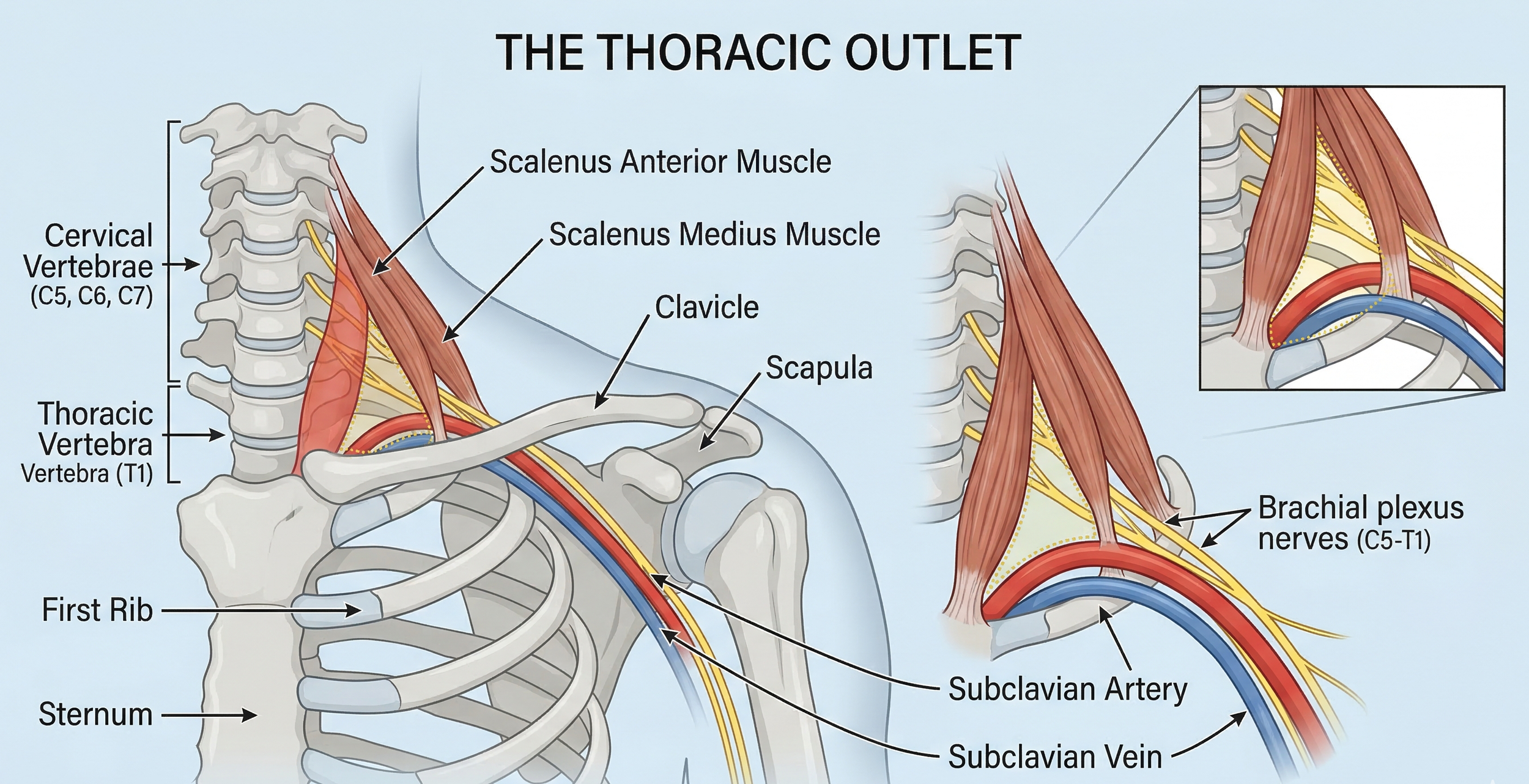
There are three types of TOS: neurogenic, venous, and arterial. Neurogenic TOS is most common, and often best treated with massage.
Neurogenic: Nerves that are compacted will fire down to the median, radial, and ulnar nerves, resulting in the pins and needles in the arm and hand and even numbness. This has been the majority of TOS diagnosis.
Venous: The subclavian vein being compressed causes several issues, including edema and/or blueness in the arm and hand, and can even result in blood clots. Venous makes up about 5% of TOS cases.
Arterial: The subclavian artery can be blocked, causing embolism or aneurysm of the artery and cold or pale hands. This case is extremely rare, making up about 1% of TOS diagnoses.
Common Causes of TOS
Thoracic Outlet Syndrome can be attributed to numerous origins, but there are three main causes:
Postural Issues
Forward Head Posture - a condition in which the head sits anteriorly in the sagittal plane (or the head is positioned over the chest instead of on top of the neck and torso where it should be). Wanna learn more about FHP? Check out the next blog post at the bottom of this page.
Rounded Shoulders
Desktop/Laptop Work
Muscular Tension
Tight Scalenes
Tight Pectoralis Minor
Overactive Upper Trapezius
Structural or Repetitive Factors
Previous injury
Carrying a heavy bag on one shoulder constantly
Repetitive overhead work (electricians, plumbers, landscapers, dog groomers, etc)
Most likely, TOS is a multi-faceted problem. If someone had a shoulder injury in college, then developed FHP while working at a desk for 10 years and doesn’t have self-care to address this issue, while also carrying a purse on the same shoulder everywhere they go, then TOS would be a likely effect of these circumstances.
How Massage Therapy Can Help
Thankfully, massage can help! Besides working to correct posture and soothe the nervous system, there are many ways a massage therapist can help with TOS and even work to lessen the symptoms you experience when not in the treatment room.
Reducing Muscular Compression: as previously mentioned, the compression of the nerves, veins, and arteries are the reason why TOS symptoms are so painful, so it makes sense that alleviating the tight muscles around these structures would be the first step. These muscles include:
Scalenes - very closely situated in the thoracic outlet, the scalenes are paramount to working with TOS. The scalenes originate from the transverse processes of the cervical vertebrae C2-C7 and insert onto the first and second ribs.
Pectoralis minor - can also contribute to TOS as the pec minor passes over the cords of the brachial plexus and axillary vessels. Pec minor originates from the third, fourth, and fifth ribs and inserts into the coracoid process of the scapula.
Upper Trapezius - tight upper traps tend to raise and roll forward the shoulders, causing that compression from the posterior angle. Bringing the shoulders back into alignment not only saves some of the strain on the thoracic outlet, but allows for further releases of scalenes and pec minor. The upper trap originates from the medial third of the superior nuchal line, the external occipital protuberance on the skull, and the nuchal ligament. It inserts onto the posterior border of the lateral third of the clavicle.
Levator scapulae - major contributor here. Since the levator scapulae can cause misalignment of the shoulder by pulling the shoulder up and rotating it forward and down, it can often be one of the main culprits of TOS. I would definitely give this muscle some attention when dealing with TOS. The levator scapulae originates from the posterior tubercles of the transverse processes of C1-C4 and inserts onto the superior medial border of the scapular spine.
Lower Trapezius - since the upper traps and levator scap are pulling everything forward, the lower traps are expected to be weakened and overstretched. Instead of releasing this muscle, I would focus on strengthening it with exercises such as prone “y” raises and prone “t” raises, which we can do together on the table to add to your session. The lower trap originates from the spinous process of the lower thoracic vertebrae, usually T4-12 and inserts onto a tubercle on the apex of the medial scapular spine.
Diaphragm - surprised by this addition? The diaphragm is your main breathing muscle. The lungs take oxygen from the atmosphere into the bloodstream and then expel the carbon dioxide, but the diaphragm actually forces the inspiration of the lungs. Almost all of the muscles in TOS also assist in inspiration (breathing) and it is worth checking on the client’s diaphragmic breathing to see if there are any restrictions. This can indicate TOS is partially a breathing problem, and working on this issue can also help to alleviate pain and tightness in the thoracic outlet.
Improving Tissue Mobility
Increasing circulation - postural corrections, release of adhesions, and warmth can all increase circulation of the thoracic region. Especially after massage, this area may feel temporarily relieved from the pain, although without the proper techniques and stretches at home, they will eventually return.
Decreasing fascial restrictions - the thoracic region is such a tight squeeze; in order to have permanently decreased pain levels, fascia must allow for movement to glide well in the shoulder girdle. Myofascial release is amazing for this purpose, and after working to soothe the taught muscles around the area as well, we would be on our way to reversing TOS symptoms.
Supporting Better Posture
Restoring balance between tight and weak muscle groups - this is where neuromuscular therapy comes in. Once the client and I are comfortable working together, I’d go in deeper to the above muscles to reset their fibers to live in a posturally positive position. The exercises below will also be in their treatment plan as an aid to the work I do.
Certain massage modalities will be more effective than others. Personally when working with TOS, I prefer to lean on myofascial work the most, with a bit of trigger point therapy when needed and careful petrissage around the thoracic outlet, though some bigger muscles, such as the traps, will require a bit of neuromuscular work. Only after working with a client once or twice do I feel comfortable moving onto neuromuscular techniques with deeper pressure. Massage therapy addresses the soft tissue component of TOS, and should provide relief by working around the thoracic outlet and never on top of it. This is a very sensitive area and will require a knowledgeable massage therapist to work with it carefully.
Exercises You Can Do At Home
One thing that benefits massage immensely is what people do at home to combat the symptoms of TOS and even prevent pain or structural issues from increasing while outside of session. There are several stretches that can help, including:
Pectoralis Minor Doorway Stretch - stand in a doorway and place your arms on the frame at about shoulder height. Slowly, lean forward until all your weight is forward, with your arms holding the doorframe, you should start to feel a nice stretch throughout the whole chest area, reducing the forward pull of the shoulders.
Scalenes Stretch - to alleviate stiffness in the neck muscles. The scalenes, especially the anterior scalenes, are very closely situated to the thoracic outlet.
Sit in a chair comfortably with your arm (affected side) holding the seat in order to lower the shoulder. Keeping the nose straight, pull the ear down to the shoulder as far as you can comfortably go. No need to overdo it here.
Keeping the arm that is bracing the chair where it is, turn the head so the nose is pointed towards the glenohumeral joint (top of the shoulder). Start to gently nod your head up and down for 30 - 60 seconds.
Thoracic Extension Over Foam Roller - this exercises will help counteract the slouching from desk work and works to alleviate pain as a result of it. This can also be done with a bolster instead of a foam roller.
Lie on the floor with your knees bent and the foam roller placed horizontally under the spine, starting just below the shoulder blades.Then, slowly release the upper back toward the floor. You can rest the head on the floor and relax the arms for a stretch
To turn this into an exercise, you’ll interlace the fingers behind the head and slowly raise up into a crunch motion. Keep the knees bent and the low back flat on the foam roller. Hold this position for 5-10 seconds and then rest. Shoot for 5-10 reps
Scapular Retraction Exercise - to help strengthen the rhomboids and mid- trapezius, which improves posture and reduces the compression of the thoracic outlet. This exercise can be done in numerous ways. In all three of these, take care to keep the shoulders down and avoid hunching, as that would go against the goal of fixing your posture and alleviating TOS.
Beginning with the easiest version, start sitting or standing with straight posture. Start to squeeze the shoulder blades together, as if you were trying to hold a pencil in between the two shoulder blades. Hold for about 5 seconds and then relax. Work towards 5-10 reps.
To make this exercise more intense, adding resistance is a wonderful way to do that. Use a band that has weight and increase the weight as these muscles get stronger.
Finally, adding shoulder retraction to your weekly workout routine is amazing for longevity. Rowing is the best exercise for this as it works to strengthen the whole mid back. Cable seated rows are great too if the cardio aspect of rowing isn’t your thing.
Deep Neck Flexor Activation - the goal here is to support better head posture and reduce pain. These exercises can include:
Chin Tucks - sitting with your neck and back straight, take two fingers and place on the chin. Retract your neck into a double chin and hold for a few seconds, and then relax. You’ll notice that there will be a small gap between your chin and your fingers. I have a video on my social media demonstrating this.
Adding the “Yes” Nod - Perform lying on your back instead of sitting, and tuck the chin again into that double chin position. This time, you’ll carefully raise the head off the floor just 1-2 inches and hold for 2-5 seconds. Then rest. Try for 5 reps.
With all of these exercises and stretches, it is imperative that you do not push past the point of discomfort. Working together with massage, we can accelerate healing and provide several days or even weeks of pain from TOS, but if these routines are performed when you’re already in pain or if doing them causes more pain. I have resources on my social media demonstrating these stretches for you, but eel free to reach out via text or email if you have any questions!
When to Seek Professional Help
A TOS diagnosis requires a doctor as mentioned above. I highly recommend if you are experiencing any of the following symptoms to make an appointment with your PCP and get referred to someone who can give you the full picture.
Numbness in the hand
Pain in the neck/shoulder
Weakness in the arm
Worsening symptoms
Symptoms that interfere with your daily activities
If any of these ring true for you, it might be time to consult a doctor.
Final Thoughts
Thoracic Outlet Syndrome can be frustrating and painful, but it’s important to know that it can be greatly helped with the right treatment. Specifically, massage therapy can work to relieve tension, soothe the nervous system, adjust posture, and release tight muscles around the thoracic outlet, leading to a decrease in pain and other debilitating symptoms.
If you suspect thoracic outlet syndrome might be preventing you from living your life, causing you pain day in and day out, consider booking a session with me to see if working together would benefit you. Massage therapy can certainly relieve the pressure of the thoracic outlet and provide relief.